The shipyard had already known what silence sounded like.
For years, the massive docks along the Redondo Peninsula in Subic Bay stood as reminders of an industry that had once employed thousands of Filipino workers. Steel had been cut there. Hull blocks had been assembled. Ships had taken shape beside the mountains of Zambales before sailing into international waters.
Then the work stopped.
When the former Hanjin shipbuilding operation collapsed in 2019, one of the Philippines’ largest shipyards fell quiet. Thousands of jobs disappeared, production ended and the enormous industrial complex was left without the constant sound of welding, fabrication and heavy machinery that had once defined it.
Seven years later, a ship emerged from the same coastline.
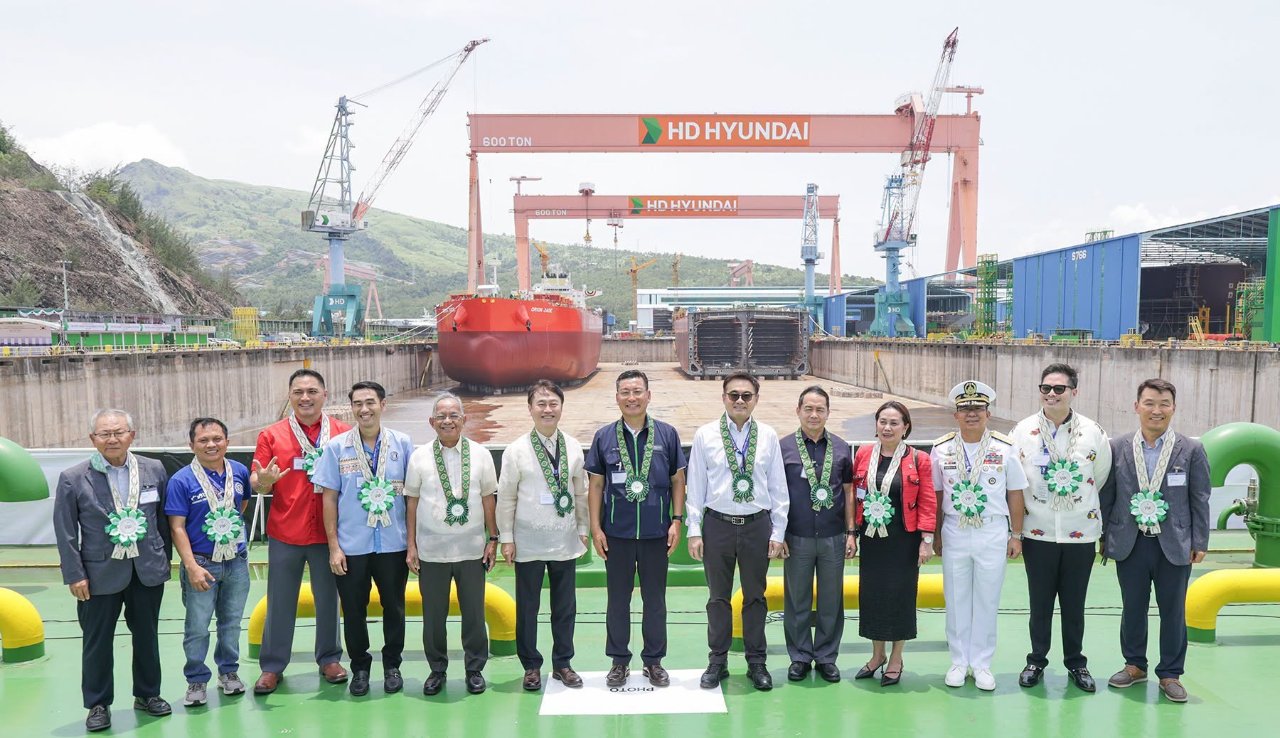
On July 28, 2026, Orion Jade was formally launched from the Agila Subic Shipyard—the first vessel fully constructed at the revived facility by HD Hyundai Heavy Industries Philippines Inc.
The vessel measures about 250 meters long, 42 meters wide and 21 meters deep. HD Hyundai has identified it as a 115,000-ton-class petrochemical carrier, the first of four vessels ordered by an Asia-based shipping company.
But the significance of Orion Jade is difficult to understand by looking only at the ship.
Its real story begins with the shipyard.
A yard given another life The former Hanjin facility was once one of the largest industrial employers inside the Subic Bay Freeport.
At its peak, shipbuilding operations supported tens of thousands of direct and indirect jobs. Filipino welders, fitters, electricians, engineers, technicians and supervisors worked inside one of Southeast Asia’s major commercial shipyards. The collapse of Hanjin Heavy Industries and Construction Philippines in 2019 abruptly changed that.
The shutdown removed a major source of employment and created uncertainty over what would happen to the massive shipbuilding infrastructure left behind.
Cerberus Capital Management eventually acquired the facility in 2022 and began redeveloping it under the name Agila Subic.
A major turning point came in 2024, when HD Hyundai entered into an agreement to lease part of the site and establish shipbuilding operations in the Philippines. By September 2025, the recovery had moved beyond agreements and investment announcements.
Steel was being cut again.
During the formal inauguration of the HD Hyundai operation on September 2, the company began construction of the first vessel in its four-ship program. Less than a year later, that steel had become Orion Jade.
Filipino hands behind a 250-meter ship Large vessels are often described through their measurements. Length. Breadth. Deadweight. Cargo capacity. Engine power.
Those numbers explain the ship. They do not fully explain the people who built it.
Behind Orion Jade are Filipino workers performing highly specialized tasks that must eventually function as one complete system once the ship leaves the yard. The hull alone requires thousands of accurately fabricated and welded components.
Piping systems have to carry fuel, water, cargo and other liquids without failure. Electrical networks must distribute power throughout the vessel. Machinery must be installed and aligned. Navigation, communication, firefighting, lifesaving and cargo-handling systems must all work according to international standards.
A mistake made inside the yard can remain hidden until the vessel is already thousands of miles away.
Shipbuilding therefore demands more than manpower. It demands precision.
MARINA reported that the revived HD Hyundai operation had already generated around 4,000 jobs by the time Orion Jade was launched. These jobs represent another side of the Filipino maritime workforce.
The Philippines is known internationally for the men and women who operate merchant vessels.
Filipino officers stand navigational watches aboard container ships, tankers and bulk carriers. Filipino engineers maintain engines designed and manufactured overseas. Filipino ratings maintain decks, secure cargo and work inside machinery spaces aboard vessels built primarily in the shipyards of China, South Korea and Japan.
Subic presents another possibility. The country that supplies the people who sail ships can also develop the people who build them. Training for an industry that disappeared There is one complication.
Shipbuilding skills cannot simply be switched back on because a shipyard has reopened.
When an industry contracts, experience disappears with it.
Workers retire. Others relocate. Younger employees enter different industries. Technical knowledge that once passed from senior workers to apprentices becomes harder to replace.
HD Hyundai and the Technical Education and Skills Development Authority have therefore begun developing training programs connected with the manpower requirements of the revived yard.
Training has covered welding and other technical areas required for ship construction, with some graduates moving directly into employment.
The partnership matters because the long-term value of the Subic project will depend partly on what knowledge remains in the Philippines.
Constructing foreign-designed ships under an international shipbuilder can create jobs. Developing Filipino specialists, supervisors, engineers, naval architects, project managers and suppliers creates an industry. The difference may determine what the shipyard looks like 10 or 20 years from now.
Four ships, not one Orion Jade is important because it is the first ship. The three vessels behind it may be even more important.
HD Hyundai secured an order for four 115,000-ton-class vessels in December 2024. The series gives the Subic operation something every commercial shipyard requires—continuity.
A shipyard cannot survive on ceremonial launches. Its docks must remain occupied. Steel must continue arriving. Workers must move from one project to the next. Design, procurement, fabrication and assembly schedules must overlap.
A successful delivery means little if the production line stops immediately afterward.
This is why the next three vessels will help determine whether Orion Jade represents the beginning of a sustained shipbuilding program or simply an impressive restart. HD Hyundai has positioned its Subic operation as part of its wider overseas production strategy and has identified tankers and bulk carriers among the vessel segments suitable for the Philippine yard.
The company already operates major shipbuilding facilities in South Korea and Vietnam.
Subic now becomes part of that network.
The advantage already built into the coastline One of the reasons the former Hanjin property remained attractive was that much of the expensive infrastructure already existed.
The shipyard includes a 550-meter dry dock, described by the Subic Bay Metropolitan Authority as the largest in the country.
Facilities of that scale allow the construction of vessels that would be impossible to build in smaller domestic yards.
Government projections have placed the shipyard’s potential capacity at millions of deadweight tons annually once operations reach maturity.
But physical size alone does not make a shipyard competitive. Modern shipbuilding is dominated by countries with deeply developed industrial ecosystems.
China, South Korea and Japan possess massive supplier networks capable of providing steel, engines, pumps, electronics, accommodation systems, navigation equipment and thousands of other components required for a single vessel. They also possess decades of design and engineering experience.
For the Philippines, the larger challenge is not proving that one large ship can be assembled in Subic.
It is increasing the amount of Philippine capability contained inside every ship that follows.
How Filipino is a Philippine-built ship? That question may eventually become one of the most important measurements of the industry's progress.
A ship can be constructed physically in the Philippines while much of its design, machinery and equipment is sourced internationally.
That is normal in global shipbuilding. What matters over time is whether local participation increases. No major shipyard produces every component domestically.
Can Philippine companies manufacture more components? Can local engineers become involved in design? Can Filipino naval architects take larger roles in production planning? Can Philippine technical schools supply workers specifically trained for modern shipyard operations? Can the country develop businesses around repair, fabrication, marine electronics, coatings, piping and equipment servicing?
If the answer increasingly becomes yes, the benefits of the Subic revival will extend far beyond one company. A shipyard can become the center of an entire maritime manufacturing ecosystem.
A second comeback is already developing Subic is not the only indication that Philippine shipbuilding may be entering another period of expansion.
Japanese shipbuilder Tsuneishi has also announced further investments in its Philippine operations.
Together, these developments have renewed government ambitions to strengthen the country's position among major shipbuilding nations. The Philippines has occupied that position before.
For years, the country ranked among the world's larger shipbuilders by gross tonnage, primarily because of large facilities operated by foreign shipbuilding groups. The challenge has always been turning that production volume into deeper domestic industrial capability.
Orion Jade therefore represents both an achievement and a test. The vessel proves that large-scale commercial construction has returned to Subic.
What comes next will show what kind of industry returns with it. When the ship finally leaves Eventually, Orion Jade will sail away from the place where it was built.
The dock will be cleared. Another hull will take its place.
The workers will move to the next project. Once the vessel enters service, most people who see it in foreign ports will never know the names of the Filipino workers who constructed it.
They will see only a tanker. They will not see the months of welding and fitting. They will not see the inspections, corrections, night shifts and training behind its hull. They will not see the workers who returned to an industry that had once disappeared from Subic. But their work will remain inside the ship.
Every bulkhead. Every pipe. Every cable. Every welded section of its 250-meter hull.
For decades, Filipino maritime professionals have carried the country's name aboard ships built elsewhere. Orion Jade carries something different.
Part of the Philippines was built into the ship before it ever reached the sea.
And after years of silence in one of the country's biggest shipyards, perhaps the most important sound in Subic is no longer the launch of a single vessel. It is the sound of the next one being built.